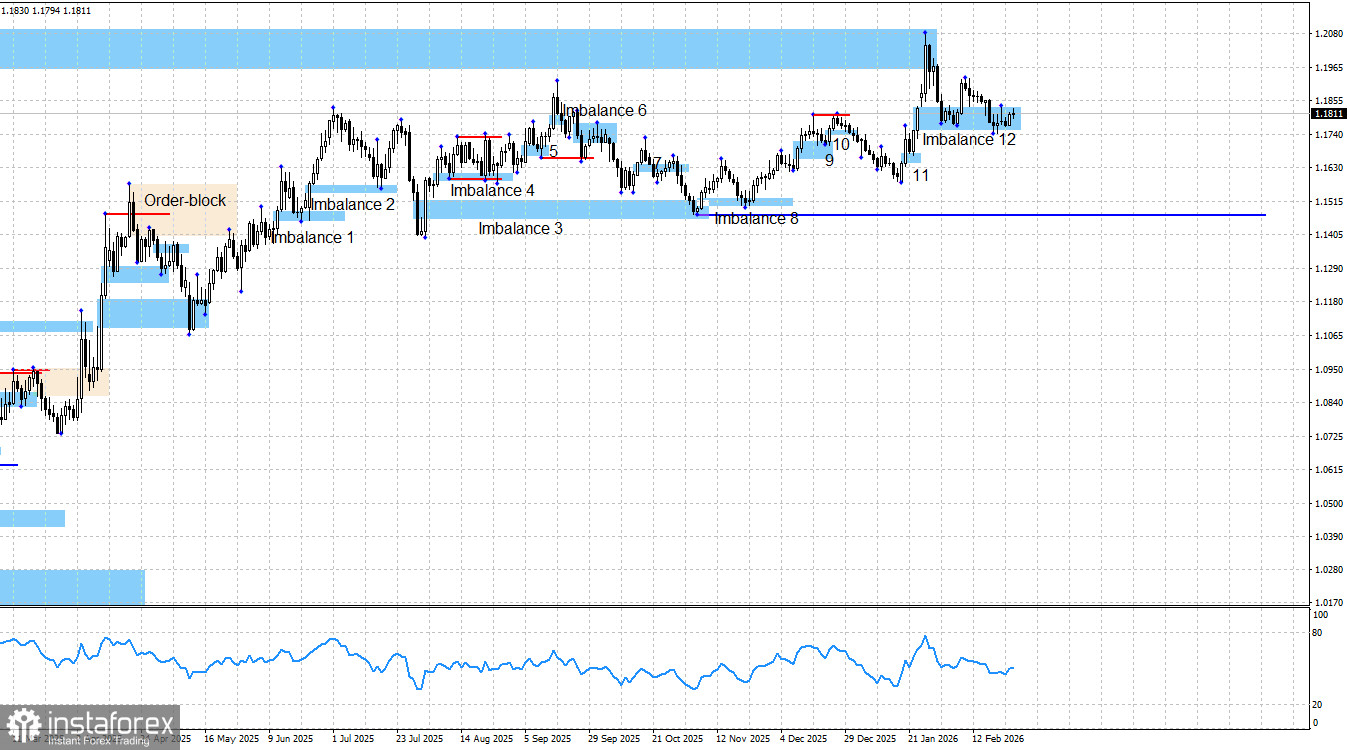
The EUR/USD pair has been in decline for thirteen consecutive days, although in reality this is not entirely accurate. Of those 13 days, the actual drop lasted no more than four days; the rest of the time the pair has been stagnant, with trader activity close to zero. I refer specifically to a decline because during this period we have not seen any upward movement either. Let me remind you that the price entered the bullish imbalance zone 12 for the second time, giving hope for a second reaction and a resumption of the bullish trend. But what conclusion can be drawn from the past six days if the price has remained inside the imbalance the entire time, showing no desire either to form a buy signal or to invalidate the imbalance itself? Thus, EUR/USD remains in a suspended state. If the imbalance is ultimately invalidated, the bears may go on the offensive for a while, but the bullish trend would still remain intact. If a reaction from imbalance 12 occurs, the growth process will resume, which in my view is the most logical scenario under current circumstances.
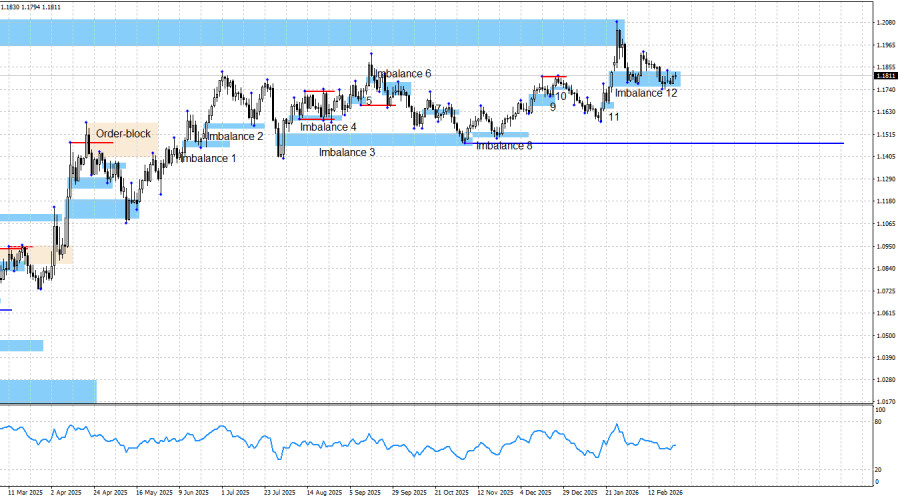
The latest bullish imbalance 12 could have been invalidated many times already. Since no reaction to this pattern has followed, there have been no grounds to open new long positions. In general, the option of taking liquidity from the February 6 low still remains, but even this scenario is currently far from clear. Liquidity grabs usually occur sharply and quickly, whereas we are observing a six-day sideways movement.
The overall chart picture continues to signal bullish dominance. The bullish trend remains intact. At the moment, the pair is close to temporarily shelving the bullish scenario, but the invalidation of imbalance 12 has not yet occurred. In any case, there are currently no bearish patterns from which traders could open short positions. And as already mentioned, the trend is bullish. Therefore, buying still appears more reasonable than selling.
The news background on Thursday was extremely weak. In the United States, jobless claims came in at 212,000, 4,000 higher than traders had expected. The market's reaction? None. Thus, the pair remains motionless, and traders continue to wait for some kind of resolution.
The bulls have had sufficient reasons for a new offensive for the past 6–7 months, and with each passing week, these reasons are at least not diminishing. These include the dovish (in any case) outlook for FOMC monetary policy, Donald Trump's overall policy (which has not changed recently), the U.S.–China confrontation (where only a temporary truce has been reached), public protests in the U.S. against Trump under the slogan "No kings," weakness in the labor market, the autumn shutdown (which lasted a month and a half), the February shutdown, U.S. military actions against certain states, criminal proceedings against Powell, the "Greenland confusion," and the deterioration of relations with Canada and South Korea. Therefore, in my view, further growth of the pair would be entirely logical.
I still do not believe in a bearish trend. The news background remains extremely difficult to interpret in favor of the dollar, which is why I do not attempt to do so. The blue line shows the price level below which the bullish trend could be considered complete. Bears would need to push the pair down about 280 points to reach it, which still appears to be a very difficult task given the current news background and chart picture, where not a single bearish pattern is present. As the nearest growth target for the euro, I had considered the bearish imbalance at 1.1976–1.2092 on the weekly chart, formed back in June 2021. This pattern has now been fully filled. Above that, two levels can be highlighted: 1.2348 and 1.2564. These levels represent two peaks on the monthly chart.
News Calendar for the U.S. and the Eurozone:
- Eurozone – Germany Unemployment Rate (08:55 UTC).
- Eurozone – Change in the Number of Unemployed in Germany (08:55 UTC).
- Eurozone – Germany Consumer Price Index (13:00 UTC).
- U.S. – Producer Price Index (13:30 UTC).
On February 27, the economic calendar contains four entries, none of which are of major significance. The impact of the news background on market sentiment on Friday may once again be extremely weak.
EUR/USD Forecast and Trading Advice:
In my view, the pair remains in the process of forming a bullish trend. Despite the fact that the news background continues to favor the bulls, the bears have regularly launched attacks in recent months. Still, I see no realistic reasons for the start of a bearish trend.
From imbalances 1, 2, 4, 5, 3, 8, and 9, traders had opportunities to buy the euro. In all cases, we saw some degree of growth, and the bullish trend remains intact. In recent weeks, we have not observed the type of movement one would like to see, but through a liquidity grab within imbalance 12, a bullish signal with renewed growth may still form.